What is mistletoe?

what is mistletoe?

What is mistletoe?

Many of us are familiar with mistletoe and the concept of kissing beneath it at this time of the year. But, have you ever stopped to wonder what exactly mistletoe is, or how or where it grow?

You may be suprised to know it is actually a parasite and grows by sinking its roots into the branches of other trees and feeding off their fluid and nutrients.

How does mistletoe grow?

Mistletoe is what is known as a hemi-parasite. This means that it can produce food for itself via photosynthesis, but it can also feed by taking fluid and nutrients from other plants - in this case, shrubs and trees.

The seeds inside the berries are very sticky, so they stick fast to and take root after being deposited on a suitable tree branch by a passing bird, after which, they sink their roots, called haustoria, into the branch to keep them steady and establish their 'parasitic straw'.

This 'straw' sucks up water, minerals and other nutrients from the host tree up into the mistletoe itself, helping it to thive all year round - even in poor sunlight when it might struggle to photosynthesize.

Which trees does mistletoe grow on?

Mistletoe grows on a variety of different host trees depending upon the part of the world, but the most common host trees for European mistletoe, are apple, oak, hawthorn, linden, poplar, willow and aspen.

Although it can grow on any of these trees, it much prefers sunny, open spots. So, one of the best places to look out for mistletoe, are among the trees in sunny, south-facing fruit orchards.

What does mistletoe look like?

Mistletoe grows in clusters, nestled among the branches of their host tree. Sometimes these clusters can be so dense, that they look like giant balls perched upon the tree.
mistletoe

They are evergreen and have smooth, opposite, oval shaped leaves and clusters of waxy white berries. Their stems are also quite distinctive, growing in wide v-shapes.

Which birds or wildlife use mistletoe?

Mistletoe berries are rich in fats and protein, making them a very nutritious food source for birds such as blackcaps, robins and mistle thrushes.

In addition, some birds, such as flycatchers, use the mistletoe balls to help support their nests and squirrels and deer have been known to feast on low-hanging mistletoe too.

Can people use mistletoe?

While mistloe may provide a nutritious snack to some of our furred and feathered friends, it is important to remember that it is in fact toxic to humans, causing vomiting, diarrhoea, liver damage and seizures.
 
That being said, mistletoe has been used historically as a medicinal plant, especially in the management of blood pressure and even today, extracts from mistletoe are used by trained herbalists and in some anti-cancer treatments.
 
And of course, there is the old Victorian christmas tradition of a kiss beneath the mistletoe.

Summary

Well, there we go!
I hope you enjoyed this little tutorial. If you have not subscribed already, feel free to sign up below and be notified of new nature study blogs and tutorials.
 
See you soon and happy nature walking,
 
Leila x

Subscribe to My Nature Nook

The Anatomy Of A Tree

the anatomy of a tree

The Anatomy Of A Tree

In this tutorial, we will learn about all the different parts, or anatomy of a tree.

Anatomy means all the little parts that come together to make one big part. In this case, a tree. So, what are the parts of a tree? Well, a tree has three main parts:

  • Roots
  • Trunk
  • Crown

Each of these three parts can be broken down further into even smaller parts.

The divisions of a tree

If we were to divide up the main parts of a tree, we will find that each one is made up of even smaller sections:

  • Roots are made up of large roots, smaller roots, tiny roots called rootlets, and even tinier root hairs
  • Tree trunks are made up of different layers too, called bark, cambium, sap-wood and heart-wood
  • The crown of a tree is made up of large branches, smaller branches and twigs

Anatomy by the seasons

In addition, a tree has other parts which come and go throughout the year - changing by the seasons.
 
  • In the spring, you might find buds, blossoms or catkins
  • During the summer, you will see leaves, flowers, fruit and berries
  • Then, in the autumn, the leaves fall off and you find nuts and seeds
  • Finally, during winter, you find only buds - unless it is a conifer or evergreen tree. (In which case you will find leaves and cones nearly all the year round.)
But did you know, even these are made up of even smaller bits. For example, leaves are made up of stems, blades and veins, while flowers have petals, sepals, anthers, stamens and ovaries.

Under the microscope

If you were to take a little piece of a tree and look at it under a microscope - any piece of the tree, you would notice that they can all be broken down even further into teeny tiny parts called cells... and even tinier parts called organelles... all the way down into atoms!

And there are many different types of cells, organs and organelles. In fact, they even arrange themselves into structures inside the tree, each of which has its own special job to do.

For example, phloem and xylem tubes run all the way up and down the tree from its roots to its leaves carrying food and water. While chlroplasts can be found inside mesothelial cells in the leaves. These have a job called photosynthesis. This means they use sunshine to help the tree make energy.

Summary

Well, there we go! So let us recap this lesson:

Each tree is made up of lots of smaller parts, arranged by structure and function.
 
While the three main parts of a tree are its roots, trunk and crown, each of these can be divided down in smaller parts and even smaller parts - some of which change according to the seasons.
 
Remember too, that every large, small and tiny part of a tree has its own special role to play in helping the tree stay strong and healthy. And they all work together to make up the anatomy of a tree.

Tree Anatomy Nature Study

Your task, is to find a tree and see if you can notice all the little parts of the tree in real life.

  • Start by noticing its roots, trunk and crown. 
  • Then look at the roots again - can you see how the bigger roots divide into smaller roots?
  • Next, follow the trunk up and see how it splits into larger and smaller branches
  • Try to reach a twig and examine it carefully.
  • Can you see any buds or leaves... or anything else?
  • Look at a leaf and trace its stem and veins.
  • What else can you see on your tree?
Finally, I would like you to find a tree stump. Take a good look and see what you can see.. If you cannot find a tree stump, take a look at our tree stump tutorial to take a look inside.

What next?

Meet our wild geese!

meet our wild geese

Meet our wild geese

Hello! I don't know about you, but I love hearing the wild geese and seeing their flocks sailing through the air at this time of the year. So I thought it would be a nice opportunity to meet some of our wild (and not quite so wild) geese. Are you ready? Lets get started!

barnacle goose

Barnacle goose

Barnacle geese can be identified by their black necks and white faces, and by the alternating blue-grey bars on their wings.

brent goose

Brent goose

Brent geese are recognised by the large white patches beneath their tails and by the strip of white around their throats.

canada goose

Canada goose

Canada geese are large with brown coloured wings and black necks with a white band around their cheeks.

white-fronted goose

White-fronted goose

White-fronted geese can be identified by the coloured ring around their eyes and the white mask above their beaks.

7C228C6B-7D99-44D0-BA53-9B09A589A5A5

Greylag goose

Greylag geese are large, have broad orange beaks, pink legs, white undertails and are light brown in colour.

egyptian goose

Egyptian goose

Egyptian geese are small and pale brown with a prominent brown eye path and a large white area on their wings.

What makes a goose, a goose?

Geese tend to be larger than ducks and smaller than swans. They often feed on land, but prefer to return to the safety of the water at night. They are also usually quite sociable and stay in constant contact with each other - hence their evocative calls as they fly.

Do all geese fly in Vs?

While we tend to envision all geese flying in a beautiful V shape as they fly, in fact, not all of them do.

  • Barnacle geese fly in large, irregular packs.
  • White-fronted geese and brent geese fly in either irregular packs or long, scattered lines.
  • Bean geese, pink-footed geese, greylag geese and Canada geese are those which are most often seen flying in typical V formation. (You can find out why geese fly in V formations here).

Where do geese fly to in the winter?

When we see geese flying in the autumn, we often assume they are migrating and leaving our shores. However, many flocks are actually arriving here from the ice-clad Tundra in search of our milder climate.
 
White-fronted geese arrive here from Greenland, Brent geese travel some 3,500 miles from Canada and Pink-footed geese herald from Iceland. As for Canada geese, they did used to travel from Canada, but these days most of the geese we see live here all year round.
 
That's right... rather than leaving, they come to our shores from further north in search of food and water. Althought with rising temperatures around the Arctic circle, less and less geese are needing to make this long, autumnal journey.

Summary

Well, there we go! I hope you enjoyed this post and feel a little familiar with how to identify some of our wild geese when you see them. To be notified about new nature walk and nature study tutorials, you can subscribe to my blog by clicking the button below x

Subscribe here

Next, check out these related links and resources:

How to tell the difference between Cowslip and Primrose

cowslip versus primrose

How to tell the difference between cowslip and primrose

Have you ever wondered what the difference is between cowslip and primrose? Well, recently, my daughter has discovered the flower fairies by Cicely Mary Barker and befriended her image of the cowslip fairy. So, she was overjoyed to spot what she thought was a cowslip growing alongside the path.

Her joy soon turned to confusion however, when she then spotted another, fairly similar flower growing a few steps away from it, being adamant that it must be another cowslip, but doubting herself because, the two plants looked a bit different.

So, after telling her their names and how to tell them apart, I thought it might be of interest to write a quick tutorial about it so that you can learn to tell the difference between cowslip and primrose too.

How to identify cowslip

Cowslip, or Primula veris, is a spring flowering plant with yellow flowers clustered at the top of tall, proud stems. It can be found growing in moist, boggy pastures, meadows and roadsides and are among the first plants to flower.

Each star or bell-like flower has five yellow petals with a deep orange spot in the middle of each petal. The five petals join beneath the star to form a longish tube, encased by a loose, leafy sheath and have a musky, vanilla-like smell.

Its leaves are oval-shaped and characteristically crinkled. However, their oval shape narrows quite suddenly along its length, leaving a long, thin, stalk-like base to the leaves, which grow rosette-like from the base of the plant.

cowslip

How to identify primrose

Primrose, or Primula vulgaris is also a spring-flowering, 5-yellow-petaled, crinkly-leaved, rosette-based plant. Like the cowslip, it also grows in moist, boggy meadows, pastures and roadsides, and is among the first plants to flower. So, how do you tell them apart?

Well, primrose flowers have wider petals than the cowslip, and their orange spots come together to form a star-like pattern in the middle of the flower. Also, unlike cowslip's proud clusters of flowers, each primrose flower grows by itself at the end of a short, single stalk.

The primrose leaves are also different, in that they taper down really gradually towards the base of the plant, so they do not have the characteristic tail of the cowslip leaves. (Although they are similarly light green and crinkly.)

primrose, spring flowers

Summary

So, in summary, here are the differences between cowslip and primrose:

  • Cowslip has clusters of small, bell-like flowers on tall stems.
  • Primrose has wide open flowers on short stems.
  • Cowslip leaves narrow down into a long, thin base
  • Primrose leaves remain broad, tapering gently towards the base.
Once you know the difference between them, telling cowslips and primroses apart is actually really easy!
 
Well. I hope you have enjoyed this little tutorial - let me know in the comments below and don't forget to subscribe if you would love to get notifications of new nature tutorials.
 
Happy nature walking and see you soon! Leila x

Subscribe to My Nature Nook

What is that yellow butterfly?

what is that yellow butterfly

What is that yellow butterfly?

Hello! Have you noticed any flashes of bright yellow fluttering around the ivy yet? This spring, we have seen many of these bright yellow butterflies and since my daughter demanded to know their name, I thought I would share it with you too. So, are you ready to learn more and find out - what is that yellow butterfly? Then, lets get started!

Our most common yellow and white butterflies

Here in Ireland and the British Isles, there are five main butterflies that might make you stop and think, 'hmmm, what is that yellow butterfly?'.

When compared side by side, two of them are actually, pale yellow, one of them is yellow- green, one of them is decidedly yellow and the last one is definitely a very bright, unmistakable yellow.

This butterfly is a male brimstone and once you have spotted one,  you will never call the other butterflies 'yellow' again. But, who are these yellow and not-so-yellow butterflies. And more importantly, how do you tell them apart from each other?

Well, they are the:

  • Small white
  • Large white
  • Green-veined white
  • Clouded yellow
  • Brimstone
Let's take a look at them...

Which are our two palest yellow butterflies?

Out of our list of five, the two palest yellow butterflies, are the small white and the large white. Both often given the generic name of 'cabbage white' (because of their love for gardeners' brassicas.)

As the names suggest, small whites are the smallest of the two butterflies and large whites are the largest. They both have creamy or pale yellow coloured underwings (seen when their wings are held upwards while resting), that are actually bright white on top.

The way to tell small white and large white butterflies apart is to look at the markings on the upper surfaces of their wings. The small white has little black tips and one to two black spots on its forewings. While the large white has a much wider, lunar crescent of black at its wing tips (and larger spots).

identifying small white and large white butterflies

What is that yellow-green butterfly?

Next, let's meet our yellow-ish green looking butterfly - the green-veined white. At first glance, with its wing out-spread, the green-veined white looks remarkably like the small and large whites, with bright white wing surfaces, a dark wing tip and a one or two dark spots.

But, once you pay attention, you will notice its wings look a lot more grainy. This graininess comes from its veins. The green-veined white, as per its name, has greenish-grey coloured wing veins.

Once it holds its wings closed though, these veins become even more prominent, being a much darker green underneath... and, the bright white of the surface gives way to a decidedly creamy-greeny-yellow colour.

identifying the green-veined white butterfly

What is that orange-yellow butterfly?

So, having met our palest-yellow and greenish-yellow butterflies, it is time to meet our orangey-yellow butterfly. The clouded yellow butterfly. This butterfly is migratory and comes and goes, sometimes in mass migrations.

At a glance, with its wings open, it could be mistaken for a painted lady or gatekeeper. Since, unlike the whites we have met above, the upper surface of this butterfly's wings are orange with a wide black margin running all around.
 
However, as soon as it closes its wings, it looks decidedly yellow (and a lot like our brimstone) but for a few little details... the wings of the clouded yellow butterfly are traced in a lovely pinky-orange colour and have an obvious white, pinkish-rimmed eye (as well as actual, beautiful bright green eyes!).
identifying a clouded yellow butterfly

What is that bright yellow butterfly?

Finally, we have arrived at our bright yellow, definitely yellow butterfly - the brimstone. Although it can also look a bit green in colour, once this butterfly (especially the male), dances into the sun, it shows itself in all its glory. A little sunbeam of butter (supposedly responsible for putting butter into butterfly!)
 
 The brimstone has pointed, leaf-shape wings with a light brown or orange spot in the middle of each wing. This design is the same for both the upper and under surfaces of the wings, making them not just easy to spot, but also easy to identify.
 
So, the next time you see a flash of sunlight dancing past and think, 'Oh, look! What is that yellow butterfly?' I hope this post has now given you a nice, easy way to identify it?
what is that bright yellow butterfly

Summary

Well, we have reached the end of this little tutorial on how to identify our most common yellow butterflies. I hope you have both enjoyed it and found it useful? If you would love to read more of my really easy nature walk tutorials, feel free to subscribe below x

What next?

Wild Garlic - Your definitive guide

wild garlic

Wild Garlic - Your definitive guide

Hello! In this tutorial, I thought I would share my definitive guide to wild garlic. Including what it is, where it grows, how to identify, harvest, store and use it and a few good-to-know look-a-likes (plus how to tell them apart). Are you ready? Lets get started!

What is wild garlic?

Wild garlic, or Allium ursinum, is a beautiful, perennial spring and summer herb found across Ireland and the British Isles (as well as Northern Europe, Canada and North America) that can often be smelled long before it is seen, thanks to its decidedly oniony-garlicky scent.

While not actually a 'garlic' per se, it is a member of the Allium family, which includes garlic, onions, leeks and chives. It is also known by many local and common names, including ramsons, buckrams, wood garlic and bear's garlic.
 

Wild garlic can be found growing wild in damp, often shady woodland corners and alongside streams and brooks. It is frequently found carpeting the forest floor alongside cuckoo's pint and lily of the valley (more about these later).

It is well known as a forager's delight, being one of the first herbs to arrive in the spring and being easy to locate and identify. However, as with any wild harvest, it should only be picked with the landowner's permission (and digging up the roots (in the wild) is illegal.)

How is wild garlic used?

Wild garlic can be eaten both raw and cooked and the entire plant is edible. This includes the roots (although illegal to dig up in the wild), young shoots, leaves, flowers, flowering stems and seeds. (Please note, while edible for humans, it is harmful for dogs.)

The best time to harvest wild garlic depends on the part you intend to use. Young leaves and shoots can be picked from early spring (around mid-February onwards). Flowers can be collected from around mid-April and the seeds can be gathered in early summer.

The easiest way to gather wild garlic is to carefully snip the bits you want with a small pair of scissors, then lay them gently in a bag or basket. Following a good wash in cold water, it can then be stored in the drawer of your fridge.

Leaves and shoots will stay fresh for around 3-4 days after you have picked them, while flowers are best used on the same day. The seed pods can be pickled and preserved like capers, making them a useful addition to your winter pantry.

You can find some great wild garlic recipes here (Great British Chefs) and here (Delicious Magazine)

How do you identify wild garlic?

Wild garlic can be identified by its leaves and smell in early spring and by its leaves, smell and flowers later in the season. Its habit of growing in large swathes also helps in identification. However, there are a few look-a-likes, which you should be aware of.

Its leaves are wide along their length, but pointed at the top, dull rather than shiny and soft to touch. Their veins run parallel to each other along the width of the leaf and are relatively spaced out. Each leaf grows singly on its own stem from the base of the plant.

The flowers are smallish, white and star-shaped. They grow together in globe-like clusters at the top of a single stem rising up from the middle of the plant. The seed heads are green and look like three little marbles joined together in the middle.

Before you collect or consume any wild garlic, it is important to rule out its two main look-a-likes - cuckoo's pint and lily of the valley. (And in the USA, snowbells and crow's poison or false garlic). Not least because they are poisonous!

how to identify wild garlic

How to tell apart cuckoo's pint and wild garlic

The most obvious difference between cuckoo's pint and wild garlic, is the smell. Wild garlic has an unmistakeable onion-garlicky scent, which cuckoo's pint does not have. So, gently crush each leaf to double check its identity (Make sure to wash your hands after).

The most dangerous time for mixing these two plants up, is early in the spring, when the shoots have not fully emerged to show the shiny, arrow-like appearance of its leaves, and the peripheral veins, which radiate out from the central vein.

Later in the year, it is easier to distinguish, with its central spadix surrounded by a light-green, hood-like sheath, and its beautiful, bright red and orange berries. It is important to note that all parts of this plant are poisonous and can cause irritation of the mouth and throat if eaten, leading to swelling and difficulty breathing.

how to distinguish between cuckoos pint and wild garlic

How to tell apart lily of the valley and wild garlic

Lily of the valley also looks uncannily like wild garlic in the spring, with the same shaped leaf and growth habit. Again, smell is the most reliable method to test it. So, gently crush a leaf to ascertain the presence of the garlicky smell. (Make sure to wash your hands after).

There are also other ways to tell the leaves apart. Lily of the valley leaves are shinier than wild garlic and their parallel veins lie much closer together. They also grow in pairs of two or three, unlike the single leaves of the garlic.

Later in the season, they can be distinguished by their flowers. While the wild garlic flowers are white, star-shaped and grow in clusters, lily of the valley flowers are white, bell-shaped and grow one-by-one along the length of the stem (like white bluebells).

Again, all parts of lily of the valley are poisonous and can cause nausea, flushing, hallucinations, arrhythmia, coma and death. So please seek help immediately if you are worried about accidental ingestion of this plant.

how to distinguish between lily of the valley and wild garlic

Summary

Well, there we go! I hope you enjoyed this tutorial and have learned all sorts of useful information about what wild garlic is, how to identify it and how to use it. Before I say goodbye though, I would just like to remind you to...

Please, please, please, never eat any plant unless you are completely certain of its identify and its edibility. If in doubt, leave it out! Also, never pick more than you need for your personal or family use. A rule of thumb is to only harvest one plant if there are seven more beside it.  Remember, our wild plants are food sources for bees, butterflies and other insects and animals too.

If you did enjoy this tutorial and would love to be notified about new tutorials, you can join the Nook by clicking the button below. Thank you for staying till the end and happy nature walking x

What next?

Identifying Spring Tree Blossom

identifying spring tree blossom

Identifying Spring Tree Blossom

Hello! In this tutorial, we are going to learn how to identify our most common our most commonly found spring tree blossoms. Are you ready? Lets get started!

apple blossom

Apple blossom

Apple flowers are white, with pink bud coverings. They have five full, rounded petals which often overlap.

blackthorn, spring flowers

Blackthorn blossoms

Blackthorn flowers also have five white petals, but they are narrower, more widely spaced and smaller than apple flowers.

cherry blossom

Cherry blossom

Cherry tree flowers have five raggedy-ended, rectangular-shaped petals. They are often white, but can also be light pink.

pear blossom

Pear blossom

Pear tree flowers have five, rounded petals and are a similar size to apple, but have a characteristic star-shape in the centre.

spring nature walk - plum blossom

Plum blossom

Plum tree flowers also have five, white, narrowly rounded petals, with long, messy, dark-tipped stamens.

Where to find spring tree blossom

I love spotting the first blossom of the spring, sometimes in gardens, sometimes in hedgerows and even through the windows of the train. In fact, spotting blossom is such a beautiful experience that people will gladly travel across the world in search of the best spots to enjoy the spectacle. But, you do not always have to travel far and wide to catch a glimpse and enjoy the smell of delicate, lacy blossom.

Look along any hedgerow from about mid-February and you are sure to spot the small white flowers of the blackthorn dotted delicately along its the branches. While, cherry trees can be found as early as January sporting their flowers in gardens, parks and city streets. (Some ornamental cherries have pompom-like flowers with more than five petals).

As for apple, plums and pears, these are great trees to look out for in orchards as you look out of the train window. But, they can also be found in hedgerows and even in previously inhabited forests. In fact, hedgerows were often deliberately planted with fruit trees to help make the most of their space and feed the local villagers a long time ago, so make great foraging locations.

Other blossoms to look out for

In addition to the flowers mentioned, you can also look out for forsythia and flowering current. Forsythia is most often found in parks and gardens and can be identified by their bright, yellow flowers, which grow all along the branches. While flowering current can has dangly clusters of small, bright pink flowers that can also be smelled from a distance. (Some people describe the smell as cat wee, but... I don't think its that bad... I shall let you decide!)

Summary

Well, there we go! I hope you enjoyed this tutorial and have a better idea now, of how to identify our most common spring tree blossoms. To be notified about new nature walk tutorials, you can join the Nook by clicking the button below x

Subscribe to My Nature Nook

How to identify our less common berries

how to identify tree berries

How to identify our less common berries

Hello! In this tutorial, we are going to learn how to identify our less common berries. Are you ready? Lets get started!

alder buckthorn

Alder buckthorn

Alder buckthorn has small berries, which ripen from green to red to dark purple and black and alternating, slightly hair leaves.

cherry laurel

Cherry laurel

Cherry laurel berries are purpley-black, grow in spikes and are poisonous. Their leaves are shiny, long and leathery.

cotoneaster

Cotoneaster

Cotoneaster has small, bright red berries, which grow on short stems in small clusters all along the branches.

dogwood

Dogwood

Dogwoods berries are very small and grow in clusters along the stems. Their leaves are bright and have long, curvey veins.

guelder rose

Guelder rose

Geulder rose berries are bright, bright red, round and hang in bunches. Their leaves have three lobes and hair underneath.

mezereon

Mezeron

Mezeron berries turn from green to orange to red and grow directly along the branches. They are also very poisonous.

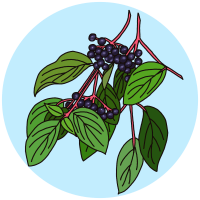
privet

Privet

Privet berries are tiny, purpley-black and grow in grape-like clusters. Their leaves are short and thin. It is poisonous.

sea buckthorn

Sea buckthorn

Sea buckthorn berries are medium sized, round and bright orange. The leaves, are long, pale and thin.

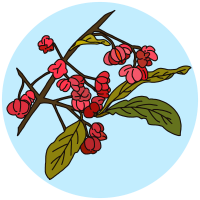
spindle

Spindle

Spindle seeds are a bright orange, nestled inside a bright pink shell. They tend to grow in conjoined fours.

spurge laurel

Spurge laurel

Spurge laurel berries are oval or egg shaped and black. They hang in clustes near the tips of the branch.

Why are these berries less well known?

When it comes to identifying wild berries, most people tend to know a select group of edible or useful hedgerow berries, including hawthorn, elder, dog rose, bramble and sloe (because, they tend to be seen almost everywhere). But, there are many, many fruit and berry-bearing plants across the British Isles, that can be found growing in scrub, woodlands, riverbanks, uplands, heaths, moors and even by the coast.

So,  why are they not so well known? Perhaps because they are not 'useful' or because they are small, or inconspicuous, so people do not notice them. Or, they notice, but do not register the fact they have noticed them because they do not know their names and so have no connection to them. Who knows?

But, known or not well known, these berries are all a part of our countryside landscape and I think it is nice to look out for them, learn to recognise them and put names to their faces... which is why I put together this tutorial today. What do you think?

Summary

Well, there we go! I hope you enjoyed this tutorial and have a better idea now, of how to identify some of our less well known tree berries. To be notified about new nature walk tutorials, you can subscribe to My Nature Nook by clicking the button below x

What next?

How to identify our most common tree seeds

how to identify our most common tree seeds

How to identify our most common tree seeds

Hello! In this tutorial, we are going to learn how to identify our most common tree seeds . Are you ready? Lets get started! 

ash keys seeds

Ash seeds (keys)

Ash seeds have a 'seed' at the top, and a long, thin papery wing underneath. They dangle in bunches from the branch tips.

field maple seeds

Field maple

Field maple seeds are wide, large and stick out horizontally when in their pairs. They are often tinged with pink.

Hornbeam seeds

Hornbeam

Hornbeam seeds consist of a seed at the top, nestled between a three-lobed papery wing around and underneath.

linden seeds

Linden

Linden seeds grow in small clusters of 2-4 at the tip of the stem, which is wrapped around by a light, membranous leaf.

london plane seeds

London plane

London plane seeds are small, tufted seeds, which grow in fuzzy balls, dangling beneath the branches.

identifying helicopter seeds - norway maple seed

Norway maple

Norway maple seeds are medium sized, frilly round the edges and grow in pairs, which stick out diagonally.

pine seed

Pine

Pine seeds come in different shapes and sizes, but have a seed at one end, and a larger, thin, papery wing.

identifying sycamore seeds, what are helicopter seeds

Sycamore

Sycamore seeds are small, and grow in pairs that hang close together, with the seeds at the top and wings beneath.

wych elm seeds

Wych elm

Wych elm seeds consist of a flat, round seed nestled in the middle of a flat, round, thin, membranous wing.

What are seeds?

Seeds are basically the babies or offspring of parent trees. They are produced following pollination of the trees' flowers and contain all the genetic material of the tree. Inside, they have a supply of food and nutrients ready to start their journey into new trees and in fact, they are specially adapted to disperse away from their parent trees by flying, floating, bouncing or rolling away (or being eaten and taken away - sometimes inside a juicy fruit!) This helps them find the space to grow and mature without competing with their parents for water, nutrients and sunlight.

Which trees have nuts and seeds?

There are many sizes and shapes of tree seeds, but usually, we only notice the larger sized seeds. The nine seeds you are likely to notice on your nature walks: ash, field maple, hornbeam, linden, London plane, Norway maple, pine, sycamore and wych elm. Some of the smaller seeds you might come across, are alder, birch and willow.

The six most common 'nut' producing trees, are: beech, hazel, horse chestnut, oak, sweet chestnut and walnut. You can learn to identify our most common nuts here.

Summary

Well, there we go! I hope you enjoyed this tutorial and have a better idea now, of how to identify our most common tree seeds. To be notified about new nature walk tutorials, you can join the Nook by clicking the button below x

what next?

Which Trees Have Catkins?

which trees have catkins

Which trees have catkins?

Hello. In this tutorial, we will be learning about which trees have catkins - and what exactly catkins are. Are you ready? let's get started!

Which trees do catkins grow on?

We have quite a few species of catkin-bearing trees, some with catkins that are more noticeable than others. And some bearing catkins, which you might not know are actually catkins! Our main catkin-bearing trees, are: alder, aspen, birch, hazel, oak, poplar, sweet chestnut, walnut and willow.

Amongst these trees, the catkins you are most likely to spot on your nature walks, are: alder, birch, hazel and willow.

alder catkins

Young alder catkins

Young, female alder catkins take the form or short, round, green cones. Young male catkins are short, thin, green and stubby, with a lattice pattern across them.

alder catkins

Mature alder catkins

Mature female alder catkins develop into woody cones, which release their seeds. Mature male catkins lengthen and soften into soft, dangly, green and pink catkins.

birch catkins

Birch catkins

Young birch catkins are short, thin, light brown and stubby, growing in clusters of 2-3. Mature catkins become soft, long yellow and dangly.

hazel catkins

Young hazel catkins

Young, male hazel catkins are short, stubby and moss green with a mustard-coloured scale trims rotating across their surface.

hazel catkins

Mature hazel catkins

Mature hazel catkins elongate to become soft, thin, dangly and a soft, mustardy yellow. Of note, the female flowers are small buds with tufty, bright red hairs.

willow catkins

Willow catkins

Willow catkins start off green or yellow and develop puffy, white-coloured seeds. So, if you see something white, puffy or fuzzy, it is most likely a type of willow.

What are catkins?

Believe it or not, catkins are actually flowers! Yes. Catkins grow on shrubs and trees and are dangly clusters of lots of tiny flowers. They just don’t look like flowers at first glance because they are not colourful and pretty.

There are two reasons for this. First, the petals on catkins are either so tiny and drab that you don’t notice them, or they do not actually have petals at all. Second, they do not need to be bright and beautiful, because they do not need to attract birds, animals or insects. The pollen on catkin-bearing tree is usually wind-borne.

Did you know, that most catkin bearing trees are coloniser or pioneer species. They are the first trees to grow in a new area - often before the habitat can support a large variety of insects or other animals. So, they depend on the wind to help fertilise their flowers. And wind does not much care for fancy blooms or pretty petals!

Are catkins male or female?

This is a good question! As you know, flowers can be male or female. The male flowers carry the pollen, which is used to fertilise the female flowers, which then produces the seeds. Some plants have their male flowers and female flowers on separate plants - these are called dioecious. And some have both their male and female flowers on the same plant - these are called monoecious. This is the same for trees.

For example, alder, hazel and birch are monoecious, which means both their male and female flowers grow on the same tree. But their flowers do not look the same. In these trees, their male flowers form the pollen-bearing catkins. While their female flowers are rather inconspicuous may be difficult to spot (at least in birch and hazel). 

However, willow is dioecious. It’s male and female flowers grow on separate trees. But, in the willows’ case, and usefully for us, they both look like our typical catkin - making them easy to spot.

Summary

Well... there we go! A brief introduction to which trees have catkins and how to identify them. I hope you enjoyed this tutorial? Let me know in the comments. Happy nature walking and see you soon!

P.S. If you enjoyed this tutorial, don't forget to subscribe below x

Subscribe Here