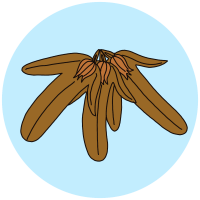
Hello! In this tutorial, we are going to learn how to identify our most common tree seeds . Are you ready? Lets get started!
Ash seeds (keys)
Ash seeds have a 'seed' at the top, and a long, thin papery wing underneath. They dangle in bunches from the branch tips.
Field maple
Field maple seeds are wide, large and stick out horizontally when in their pairs. They are often tinged with pink.
Hornbeam
Hornbeam seeds consist of a seed at the top, nestled between a three-lobed papery wing around and underneath.
Linden
Linden seeds grow in small clusters of 2-4 at the tip of the stem, which is wrapped around by a light, membranous leaf.
London plane
London plane seeds are small, tufted seeds, which grow in fuzzy balls, dangling beneath the branches.
Norway maple
Norway maple seeds are medium sized, frilly round the edges and grow in pairs, which stick out diagonally.
Pine
Pine seeds come in different shapes and sizes, but have a seed at one end, and a larger, thin, papery wing.
Sycamore
Sycamore seeds are small, and grow in pairs that hang close together, with the seeds at the top and wings beneath.
Wych elm
Wych elm seeds consist of a flat, round seed nestled in the middle of a flat, round, thin, membranous wing.
What are seeds?
Seeds are basically the babies or offspring of parent trees. They are produced following pollination of the trees' flowers and contain all the genetic material of the tree. Inside, they have a supply of food and nutrients ready to start their journey into new trees and in fact, they are specially adapted to disperse away from their parent trees by flying, floating, bouncing or rolling away (or being eaten and taken away - sometimes inside a juicy fruit!) This helps them find the space to grow and mature without competing with their parents for water, nutrients and sunlight.
Which trees have nuts and seeds?
There are many sizes and shapes of tree seeds, but usually, we only notice the larger sized seeds. The nine seeds you are likely to notice on your nature walks: ash, field maple, hornbeam, linden, London plane, Norway maple, pine, sycamore and wych elm. Some of the smaller seeds you might come across, are alder, birch and willow.
The six most common 'nut' producing trees, are: beech, hazel, horse chestnut, oak, sweet chestnut and walnut. You can learn to identify our most common nuts here.
Summary
Well, there we go! I hope you enjoyed this tutorial and have a better idea now, of how to identify our most common tree seeds. To be notified about new nature walk tutorials, you can join the Nook by clicking the button below x
what next?
Like this:
LikeLoading…
Meet Our Common Tree Nuts
Meet Our Wild Nuts
Hello! In this tutorial, we are going to meet some of the most common tree nuts you are likely to find on your countryside nature walk and learn how to identify them. Their names are:
Beech
Hazel
Horse chestnut
Oak
Sweet chestnut
Walnut
Are you ready to meet them? Lets get started!
Which trees have nuts and seeds?
There are many sizes and shapes of tree seeds, but usually, we only notice the larger sized seeds. In addition to the trees mentioned here, there are also nine other seed-bearing trees you may spot on your nature walks: These are ash, field maple, hornbeam, linden, London plane, Norway maple, pine, sycamore and wych elm, which you can learn more about on my tree seeds tutorial.
How to identify our most common nuts
Acorns
Acorns come in all shapes and sizes, but usually have an oval shaped seed nestled in a textured cup.
Beech nuts (mast)
Beech nuts are triangular and nestled inside a three-bladed husk, which is smooth inside and spiky outside.
Hazel (filberts)
Hazelnuts are round with a little crinkled gather at the top and sit inside a feathery, leafy husk.
Horse chestnuts (conkers)
Horse chestnuts are round, deep chestnut brown with a pale spot beneath and grow inside a tough, spiky, rounded shell.
Sweet chestnuts
Sweet chestnuts are a beautiful reddish brown, with pale tufts on top and often grow in pairs inside a spikey shell.
Walnuts
Walnuts are a light brown, crinkly nut, growing inside a tough, fibrous shell, inside a tough, apple-green outer husk.
What are nuts?
Nuts and seeds are basically the babies or offspring of parent trees.
They are produced following pollination of the trees' flowers and contain all the genetic material of the tree and inside, they have a supply of food and nutrients ready to start their journey into new trees. In fact, even their shapes are specially designed to help give the seedlings a head start in life.
Because, in order to grow up strong and healthy, trees need space to grow and access to good sunlight. So, if they fell and sprouted right under their parent, they would be competing with them for space, sun and nutrients.
In order to solve this little problem, nuts have found different ways to help themselves disperse and travel away from their parent tree.
How are nuts adapted to travel?
To help them on their journey, seeds and nuts have adapted various tricks to help them travel.
Some nuts are hard and round, like horse chestnuts. This way, when they fall, they bounce and roll away. Others make themselves tasty to wildlife like squirrels (like acorns and hazelnuts), who carry them away and even bury them in the earth.
Yet others have little pockets or air to make them bouyant so they float. Or, they have wings to fly away.
But, you may be wondering, how can they grow if they are eaten? Well... think about how many acorns the squirrels bury... and in how many places. No matter how many they eat, there will always be some left over or forgotten about. These are the nuts which grow.
How do nuts avoid being eaten?
Aside from dispering away from their parents, another problem that nuts and seeds face, is surviving long enough to mature and be ready for the seed to grow. Because, it is not good for the nuts to be eaten or carried away from the tree before they are ready. So, they have developed various tricks here too.
Look at the beech nuts, horse chestnuts and sweet chestnuts above. Can you see their spines? The spikes and spines on these nuts deter animals from picking them up or eating them until the seed inside is ready.
Once they are ready, these husky, spiky shells split open - often as the nuts hit the ground when they fall. This reveals the tasty, non-spiky nuts inside, ready for the animals to dig them out.
Some nuts use a trick of making themselves taste disgusting too. Like horse chestnuts. These contain a chemical called saponins and any animal who eats one, will be left with a horrible taste in their mouth and so learn to leave them alone.
Summary
Well, there we go! In this tutorial, we have met six of our most common tree nuts and learn how to identify them. Can you remember their names? They are:
Beech
Hazel
Horse chestnut
Oak
Sweet chestnut
Walnut
In addition to meeting these nuts, we also learned a little bit about what they are (shelter and protection for baby trees) and how even their shapes help out the little trees disperse and avoid being eaten or carried away too soon.
Wild nut nature study
Right! Are you ready for your wild nuts nature study?
Your task, is to take a nature walk and look for nuts! I want you to:
Try and identify the nuts you find
Handle the nuts and look at their shapes, weight, textures and colours
Examine their husks - examine the insides and the outsides of the husks. How do they feel? How are they different?
Think about how the shape of the nut and its husk or coating might help it travel or avoid being eaten
Subscribe to My Nature Nook
Like this:
LikeLoading…
How to identify our most common helicopter seeds
Identifying Helicopter Seeds
In this tutorial, we will learn about how to identify helicopter seeds.
Here in Ireland and the British Isles, you are most likely to find the following helicopter seeds:
Field maple
Norway maple
Sycamore
These three seeds may look very similar, but there are some easy ways to tell them apart. So, let's take a look and learn a bit about them.
How to identify our helicopter seeds
Field maple seeds
Field maple seeds have the greatest angle of the three and grow almost horizontally away from each other. Each seed is curved in an upward scoop from the bottom.
Norway maple seeds
Norway maple seeds also grow far apart from each other, but at a closer angle than field maple seeds. Each seed is broad at the tip and has a wavy appearance to its edges.
Sycamore seeds
Compared to field maple and Norway maple, sycamore seeds are smaller and they grow much closer together. Each seed is rounded at the tip and curves outwards at the bottom.
What are helicopter seeds?
Have you ever asked yourself, what are helicopter seeds and why do they have wings?
Well, there are two types of flying seed - parachute seeds and winged seeds. Helicopter seeds are winged seeds. Their wings are single, stiff, flat membranes, which are attached to the actual 'seed' bit and designed to help the seed catch the wind as it falls from the tree and fly away. Theis helps it move away from its parent tree so it is not competing for food, water and sunlight.
The reason they are called helicopters is because of the way they spin as they fall from the tree. But, they have other names too, including spinning jennies, whirligigs and whirlibirds. But their proper name is a samara.