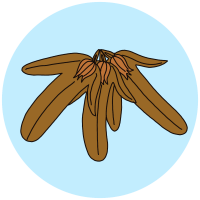
Hello! In this tutorial, we are going to learn how to identify our most common tree seeds . Are you ready? Lets get started!
Ash seeds (keys)
Ash seeds have a 'seed' at the top, and a long, thin papery wing underneath. They dangle in bunches from the branch tips.
Field maple
Field maple seeds are wide, large and stick out horizontally when in their pairs. They are often tinged with pink.
Hornbeam
Hornbeam seeds consist of a seed at the top, nestled between a three-lobed papery wing around and underneath.
Linden
Linden seeds grow in small clusters of 2-4 at the tip of the stem, which is wrapped around by a light, membranous leaf.
London plane
London plane seeds are small, tufted seeds, which grow in fuzzy balls, dangling beneath the branches.
Norway maple
Norway maple seeds are medium sized, frilly round the edges and grow in pairs, which stick out diagonally.
Pine
Pine seeds come in different shapes and sizes, but have a seed at one end, and a larger, thin, papery wing.
Sycamore
Sycamore seeds are small, and grow in pairs that hang close together, with the seeds at the top and wings beneath.
Wych elm
Wych elm seeds consist of a flat, round seed nestled in the middle of a flat, round, thin, membranous wing.
What are seeds?
Seeds are basically the babies or offspring of parent trees. They are produced following pollination of the trees' flowers and contain all the genetic material of the tree. Inside, they have a supply of food and nutrients ready to start their journey into new trees and in fact, they are specially adapted to disperse away from their parent trees by flying, floating, bouncing or rolling away (or being eaten and taken away - sometimes inside a juicy fruit!) This helps them find the space to grow and mature without competing with their parents for water, nutrients and sunlight.
Which trees have nuts and seeds?
There are many sizes and shapes of tree seeds, but usually, we only notice the larger sized seeds. The nine seeds you are likely to notice on your nature walks: ash, field maple, hornbeam, linden, London plane, Norway maple, pine, sycamore and wych elm. Some of the smaller seeds you might come across, are alder, birch and willow.
The six most common 'nut' producing trees, are: beech, hazel, horse chestnut, oak, sweet chestnut and walnut. You can learn to identify our most common nuts here.
Summary
Well, there we go! I hope you enjoyed this tutorial and have a better idea now, of how to identify our most common tree seeds. To be notified about new nature walk tutorials, you can join the Nook by clicking the button below x
what next?
Like this:
LikeLoading…
Which Trees Have Catkins?
Which trees have catkins?
Hello. In this tutorial, we will be learning about which trees have catkins - and what exactly catkins are. Are you ready? let's get started!
Which trees do catkins grow on?
We have quite a few species of catkin-bearing trees, some with catkins that are more noticeable than others. And some bearing catkins, which you might not know are actually catkins! Our main catkin-bearing trees, are: alder, aspen, birch, hazel, oak, poplar, sweet chestnut, walnut and willow.
Amongst these trees, the catkins you are most likely to spot on your nature walks, are: alder, birch, hazel and willow.
Young alder catkins
Young, female alder catkins take the form or short, round, green cones. Young male catkins are short, thin, green and stubby, with a lattice pattern across them.
Mature alder catkins
Mature female alder catkins develop into woody cones, which release their seeds. Mature male catkins lengthen and soften into soft, dangly, green and pink catkins.
Birch catkins
Young birch catkins are short, thin, light brown and stubby, growing in clusters of 2-3. Mature catkins become soft, long yellow and dangly.
Young hazel catkins
Young, male hazel catkins are short, stubby and moss green with a mustard-coloured scale trims rotating across their surface.
Mature hazel catkins
Mature hazel catkins elongate to become soft, thin, dangly and a soft, mustardy yellow. Of note, the female flowers are small buds with tufty, bright red hairs.
Willow catkins
Willow catkins start off green or yellow and develop puffy, white-coloured seeds. So, if you see something white, puffy or fuzzy, it is most likely a type of willow.
What are catkins?
Believe it or not, catkins are actually flowers! Yes. Catkins grow on shrubs and trees and are dangly clusters of lots of tiny flowers. They just don’t look like flowers at first glance because they are not colourful and pretty.
There are two reasons for this. First, the petals on catkins are either so tiny and drab that you don’t notice them, or they do not actually have petals at all. Second, they do not need to be bright and beautiful, because they do not need to attract birds, animals or insects. The pollen on catkin-bearing tree is usually wind-borne.
Did you know, that most catkin bearing trees are coloniser or pioneer species. They are the first trees to grow in a new area - often before the habitat can support a large variety of insects or other animals. So, they depend on the wind to help fertilise their flowers. And wind does not much care for fancy blooms or pretty petals!
Are catkins male or female?
This is a good question! As you know, flowers can be male or female. The male flowers carry the pollen, which is used to fertilise the female flowers, which then produces the seeds. Some plants have their male flowers and female flowers on separate plants - these are called dioecious. And some have both their male and female flowers on the same plant - these are called monoecious. This is the same for trees.
For example, alder, hazel and birch are monoecious, which means both their male and female flowers grow on the same tree. But their flowers do not look the same. In these trees, their male flowers form the pollen-bearing catkins. While their female flowers are rather inconspicuous may be difficult to spot (at least in birch and hazel).
However, willow is dioecious. It’s male and female flowers grow on separate trees. But, in the willows’ case, and usefully for us, they both look like our typical catkin - making them easy to spot.
Summary
Well... there we go! A brief introduction to which trees have catkins and how to identify them. I hope you enjoyed this tutorial? Let me know in the comments. Happy nature walking and see you soon!
P.S. If you enjoyed this tutorial, don't forget to subscribe below x
Subscribe Here
Like this:
LikeLoading…
10 Common tree buds and how to identify them
Let's learn meet some common tree buds
Hello. In this tutorial, we are going to meet 10 of our most common tree buds and learn how to identify them. Are you ready? Let's get started!
Why are buds important in tree identification?
Buds are a really useful way (and sometimes, one of the few ways) of identifying trees during the winter and early spring when they don’t yet have any leaves or flowers to help identify them. Yet, we so often overlook or forget about them.
At first glance, it might seem surprising to think about the possibility of identifying a tree by those little knobbly bits on its twigs. But, once you open your eyes and start noticing their little details, you will soon realise that tree buds, those knobbly things’, are often as different from one another as leaves or flowers ‘those green or pretty things’.
Alder tree buds
Alder buds are alternate, a soft, purple colour and attached to the twig via little pegs.
Ash tree buds
Ash buds are opposite and fairly large and charcoal-black.
Beech tree buds
Beech buds are long, thin, tapered and chestnut brown and grow out at an angle away from the twig.
Cherry tree buds
Cherry buds are small, thin, tightly closed and grow in clusters all along the twig.
Hazel tree buds
Hazel buds are blunt, rounded, soft green and alternate, with the twig angled between each pair of buds.
Hawthorn tree buds
Hawthorn buds are short, blunt, reddish brown and knobbly.
Horse chestnut tree buds
Horse chestnut buds are quite large, egg-shaped, sticky, shiny and grow near the ends of the branches.
Oak tree buds
Oak tree buds are fat, blunt, pinky-reddish brown and grow in small clusters near the ends of the branch.
Rowan tree buds
Rowan tree buds are long, scruffy, hairy and tightly stuck to the branches.
Sycamore tree buds
Sycamore tree buds are opposite, egg-shaped, green and has little black points at the end of each bud scale.
Summary
Well... there we go! A brief introduction to our 10 common tree buds. I hope you enjoyed this tutorial? Let me know in the comments. Happy nature walking and see you soon!
P.S. If you enjoyed this tutorial, don't forget to subscribe x
What next?
Like this:
LikeLoading…
How To Identify Conifer Trees
How do you identify conifers?
Hello! In this tutorial, we are going to learn all about how to identify conifers. You will soon be able to tell your pine from your spruce, your spruce from your fir, as easy as abc. Are you ready? Lets get started!
Let's learn how to identify conifer trees
Cedar
True cedar leaves are long, round in cross section and grow in clusters, like pine, but are shorter than pine and stiffer. They are also highly scented. Their cones are small, upright and dainty.
Cypress
Cypress leaves are flat like fir, but have a scaly appearance. Their cones are small, round and look like wooden berries.
Douglas fir
Douglas fir leaves are short, soft and singular with a white line underneath. Their cones dangle downwards and have little mouse-feet projections between their scales.
Fir
Fir leaves are short and singular like spruce, but are soft, flexible and flat in cross-section, with two white lines underneath and are attached by tiny round cups. The cones stand upwards on the branch and can be quite colourful. Their branches arch downwards and grow packed tightly together.
Hemlock
Hemlock leaves are flat, like yew, but very vary in length and are soft and floppy, with white bands underneath. They are attached by delicate pegs. Their cones are oval, with large, loose plates. The branches are soft, flexible and droppy and the whole tree looks dainty and feathery.
Juniper
Junipers actually have two different leaf formations. Some specied have short, sharp, spikey leaves; while other specied have flat, ferny leaves. Their cones take the form of small, round, blue-coloured berries.
Larch
Larch leaves are medium lenght, round in cross section and grow in rosettes around the branch. Its cones are small, circular, dainty and frilly. They grow on top of the branch.
Pine
Pine leaves are long, round in cross-section and grow in little bunches (fascicles), with a knot or twist at its base. Their cones are egg-shaped, hard and woody and they dangle down beneath the branches. The bark is reddish in colour and plated in texture and the trees themselves are very tall, with their branches concentrated at the top.
Spruce
Spruce leaves are short, stiff, singular, square in cross-section and attached by little wooden pegs. Their cones are long, thin, sleek and bendy and they dangle down beneath its upward arching branches.
Yew
Yew leaves are flat with pointy ends and attached by little green stalks. Their cones are actually small red berries with cave-like depression underneath and a seed hidden inside. The bark is darks and flaky and the whole tree looks dark and dense.
So, how do you identify conifers?
At first, identifying conifers can seem like an impossible task - they are all dark green, with needly leaves and cones. But, once you know what to look for, you will quickly realise that underneath that mass of green needles, they are actually quite different.
How many types of conifer are there?
Here in the UK, you are likely to come across one of ten types of conifer: cedar, cypress, fir, hemlock, juniper, larch, pine, sequoia, spruce and yew. And to identify them, you need four little details - their leaves, cones, branches and bark.
How to identify conifers by their leaves
When deciding to identify a conifer tree by looking at its leaves, the main things we need to pay attention to, are the size and shape of the conifer’s leaves, their texture and how they are attached to the twigs.
Size or length - Are all the tree’s needles the same length or are they different lengths? Are they long or short?
Shape - Are the needles round, square or flat?
Texture - Are the needles smooth and sleek or are they scaly? Do they have any surface (or undersurface) markings?
Attachment - Are the leaves arranged singly or in groups or clusters? Also, are they attached straight to the stem or are they joined to it by little pegs?
Pine fascicle with twist
Spruce on pegs
Fir with suction cups!
Identifying conifers by their cones
When using cones to help identify a conifer tree, we need to know their shape, flexibility, scale shape and their position on the branch.
Shape - Is the cone egg-shaped, round or elongated? Does it look sleek, bumpy or frilly?
Flexibility - Is the cone hard and woody or can you flex it (even a little bit)?
Scales - Are the scales thick or thin? Angular, rounded or wavy?
Position - Do the cones dangle down beneath the branches or stand up on top like candles?
Lastly, does a conifer look like it has berries instead or cones? Or even minature cones?
Identifying conifers by their branches
This may not be the easiest way to identify conifers, but can provide an extra clue. The main things to look for are the location of the branches on the tree trunk, their bendiness and their general direction of growth.
Location - Are the branches are clustered at the top of the tree or spread out along its whole length? Are they spaced apart or packed closely together?
Bendiness - Can you flex the branches or are they rigid?
Direction - Do the branches curve upwards or downwards? Or do they appear to stick straight out to the sides?
Identifying conifers by their bark
As with many trees, bark can only be used as a reliable clue when looking at younger trees. Because, as the tree matures, its bark thickens and it loses its quirks and identifiable personality. But, basically, you want to look at two things:
Texture - Is the bark flaky, scaly or fibrous?
Colour - Does the bark look grey, red or brown?
Summary
Well, there we go! I hope you enjoyed this tutorial and have a better idea now, of how to identify our most common conifer trees. If you would like to learn more about identifying trees, why not check out my tutorials on identifying nuts, seeds, leaves or berries.
To be notified about new nature walk tutorials, you can join the Nook by clicking the pink button below x
Hello! In this tutorial, we are going to learn how to identify some of our most common tree by their leaves. Specifically, we will learn how to identify leaves by their shape. Are you ready? Lets get started!
(To help make it easier for you, I have divided the leaves into groups, so you can use these quick links to jump where you need to go x)
Norway maple leaves are sharp at the tips compared to field maple and sycamore.
Field maple
Field maple leaves are much rounder at the tips and smaller than Norway maple and sycamore.
Sycamore
Sycamore leaves are softer at the tips than sycamore, but sharper than field maple.
Palmate (hand-like) leaves
Horse chestnut
Horse chestnuts are the most common tree you are likely to find with characteristically hand-shaped leaves.
Spiky leaves
Holly
Holly trees have dark, shiny, very spiky leaves. Another spiky shrub (and a garden run away), is mahonia.
Lobed or wavy leaves
Oak
Oak trees have distinctively lobed leaves, often very gnarled, spreading branches - and a helpful clue - acorns!
Hawthorn
Hawthorn trees are usually a dense tangle of lichen-covered, shrubs with thorny branches.
Pinnate (or feather-like) leaves
Ash
Ash trees have thin leaflets, often more than 5 to a stem and clustered at the tips of the branches.
Elder
Elder leaves are rounder than ash and often darker and thicker. In addition, it is a more-shrub-like plant.
Rowan
Rowan trees have skinny, leaflets with saw-like edges. They also often have white lichen spots on their bark.
Leaf-shaped leaves
Beech
Beech tree leaves are quintessentially 'leaf' shaped and leathery. They are often slightly wavy around the edges.
Hornbeam
Hornbeam leaves might look like beech leaves, but they have deep valleys between their veins.
Wych elm
Wych elm leaves can be spotted by their asymmetrical leaf base and their pointy (sometimes 3 pointed) tip.
Round leaves
Aspen
Aspen leaves are rounded (sometimes slightly pointed), very delicate-looking leaves with gently-waving edges.
Hazel
Hazel leaves are larger than aspen with a marked tip. They are also narrow at the base, wider at the top.
Linden
Linden leaves look like upside down hearts, with a curved base, wide middle and widely pointed tip.
How do you identify trees by their leaves?
Sometimes (but not always) one of the easiest ways to identify a tree is by looking at its leaves. Your clues are the shape, size, margins, tips and bases and arrangement of the leaves.
This might sound like a lot of things to look at, but really, usually, you only need to focus on two things - the arrangement of the leaves and their shape. These help you to narrow the leaf down. Then, the extra details like the margins, tips and bases just provide extra clues to help you confirm what it is.
The two types of leaf arrangement
When looking at leaves, I like to start wide and then move in and the best way to start wide with leaves, is by looking at their arrangement and how they attach to the branches or stems. There are two types of leaf arrangement: simple and compound.
Simple leaves are individual leaves, each with their own special connection to the twig or tree branch. While, compound leaves are a group of leaves which join together and share a connection to the tree branch. These can be further divided into pinnate and palmate.
Pinnate-type compound leaves consist of individual leaflets that join along a main stem and attach to the branch via the main stem. While, palmate-type compound leaves are individual leaflets that radiate out and join in one central point, from which a shared stem then emerges to attach them to the tree branch.
Simple leaf
Pinnate leaf
Palmate leaf
Summary
Well... there we go! In this lesson, we met some of our most common tree leaves and learned how to identify them all. I hope you feel more confident about identifying them now?
Just remember, there are many, many different trees - all with different leaves - and I have only covered a few of them here.
Tree leaves nature study
Right! Now it is time for your tree leaves nature study.
Your task, is to go out on a nature walk and find some tree leaves.
Try and identify the leaves you find using the downloadable guide
Handle the leaves and get to know their colours, size and shape.
Notice the details of the leaves - their stems and how they attach to the leaf
Look at the arrangement of the veins running through the leaf
Run your fingers over the edge of the leaves and feel their margins
Examine the underside of the leaves for fine hairs or fuzziness
See how bouncy, crisp or delicate the leaf might be
Disclaimer: This page contains affiliate links, so I may recieve a small commission if you choose to purchase any item. This will not affect the price you pay, but it will help me keep this site going x
About this tutorial
Hello! In this tutorial, we are going to meet some of the most common berries you are likely to find on a late summer or early autumn walk in the country. Are you ready? Lets get started!
Which are our most common hedgerow berries?
One of the best places to start looking for wild fruits and berries are the hedgerows bordering our roads and country lanes. And, if you take a stroll and keep your eyes open in late summer and autumn, you are sure to see all sorts of wild fruit adorning the twigs and branches. Some of these berries are edible and some of them are poisonous - so be sure to know with exact certainty that the berries you are picking are edible if you go foraging.
Here are some of the wild fruits and berries you can expect to meet:
Blackthorn (sloe)
Blackthorn berries can be black or deep blue with a light blue bloom. They are small, round and have long thorns.
Brambles (blackberries)
Brambles are one of our most easily identified hedgerow berries and I am sure, need no description.
Damson
Damsons can be purple, reddish or blueish, and egg-shaped or round. Unlike blackthorn, they do not have thorns.
Elder
Elderberries are small, deep-purple or black berries growing in large clusters joined by purple or red stems.
Guelder rose
Guelder rose berries are bright red - almost translucent, nearly perfectly round and hang in clusters.
Hawthorn
Hawthorn berries are slightly elongated with a raised bottom. They are deep red and hang in small bunches.
Honeysuckle
Honeysuckle berries are smallish, round and bright red. They grow in small clusters between the paired leaves.
Rowan (mountain ash)
Rowan berries hang in clusters and look like minature, bright orange or red apples, with inward dimpled bases.
Wild rose
Wild rose hips are, smooth, orangey-red egg-shaped, pinched at the bottom and ending in a slightly tufted base.
What other wild berries are there?
In addition to the fruits and berries mentioned above, there are of course many others. When trying to identify them, remember, that some berries change colour as they mature, e.g. tutsan starts off red and turns black. Here area few of them:
Please remember, never attempt to eat or taste any wild berry unless you are absolutely certain of its identity and know it is safe to eat. Many of our most tasty-looking berries are poisonous. With that said, here are a few of our most common edible wild fruits: bilberries, blueberries, bramble (wild blackberries), elderberries, hawthorn, raspberries, rosehips, rowan, damson, wild raspberries, wild strawberries and sloe (blackthorn).
Please note, that even though these are edible, some of them need to be cooked before they are eaten. (Much like potatoes... they are edible too, but only once cooked!)
Which berries are poisnous?
Once again, remember, never eat or taste any berry, unless you are absolutely sure of its identity and the fact that it is safe to eat. Some of our most common poisonous berries, are: bittersweet (woody nightshade), black bryony, deadly nightshade, holly, honeysuckle, ivy, lords and ladies (cuckoo pint), spindle and yew (seeds).
Where else do wild berries grow?
Anywhere shrubs and trees and plants grow, you can find wild fruits growing: Along cliffs and coast lines; high up on the slopes of moors and mountains; down amongst the bogs and swamps; beside lakes and riverbanks; in fields and meadows; scattered amongst our forests and hedgerows; and hidden in wastelands and thickets.
Summary
Well, there we go! I hope you enjoyed this tutorial and have a better idea now, about some of our most common wild hedgerow berries. To be notified about new nature walk tutorials, you can join the Nook below x
Subscribe to My Nature Nook
Like this:
LikeLoading…
Meet Our Common Tree Nuts
Meet Our Wild Nuts
Hello! In this tutorial, we are going to meet some of the most common tree nuts you are likely to find on your countryside nature walk and learn how to identify them. Their names are:
Beech
Hazel
Horse chestnut
Oak
Sweet chestnut
Walnut
Are you ready to meet them? Lets get started!
Which trees have nuts and seeds?
There are many sizes and shapes of tree seeds, but usually, we only notice the larger sized seeds. In addition to the trees mentioned here, there are also nine other seed-bearing trees you may spot on your nature walks: These are ash, field maple, hornbeam, linden, London plane, Norway maple, pine, sycamore and wych elm, which you can learn more about on my tree seeds tutorial.
How to identify our most common nuts
Acorns
Acorns come in all shapes and sizes, but usually have an oval shaped seed nestled in a textured cup.
Beech nuts (mast)
Beech nuts are triangular and nestled inside a three-bladed husk, which is smooth inside and spiky outside.
Hazel (filberts)
Hazelnuts are round with a little crinkled gather at the top and sit inside a feathery, leafy husk.
Horse chestnuts (conkers)
Horse chestnuts are round, deep chestnut brown with a pale spot beneath and grow inside a tough, spiky, rounded shell.
Sweet chestnuts
Sweet chestnuts are a beautiful reddish brown, with pale tufts on top and often grow in pairs inside a spikey shell.
Walnuts
Walnuts are a light brown, crinkly nut, growing inside a tough, fibrous shell, inside a tough, apple-green outer husk.
What are nuts?
Nuts and seeds are basically the babies or offspring of parent trees.
They are produced following pollination of the trees' flowers and contain all the genetic material of the tree and inside, they have a supply of food and nutrients ready to start their journey into new trees. In fact, even their shapes are specially designed to help give the seedlings a head start in life.
Because, in order to grow up strong and healthy, trees need space to grow and access to good sunlight. So, if they fell and sprouted right under their parent, they would be competing with them for space, sun and nutrients.
In order to solve this little problem, nuts have found different ways to help themselves disperse and travel away from their parent tree.
How are nuts adapted to travel?
To help them on their journey, seeds and nuts have adapted various tricks to help them travel.
Some nuts are hard and round, like horse chestnuts. This way, when they fall, they bounce and roll away. Others make themselves tasty to wildlife like squirrels (like acorns and hazelnuts), who carry them away and even bury them in the earth.
Yet others have little pockets or air to make them bouyant so they float. Or, they have wings to fly away.
But, you may be wondering, how can they grow if they are eaten? Well... think about how many acorns the squirrels bury... and in how many places. No matter how many they eat, there will always be some left over or forgotten about. These are the nuts which grow.
How do nuts avoid being eaten?
Aside from dispering away from their parents, another problem that nuts and seeds face, is surviving long enough to mature and be ready for the seed to grow. Because, it is not good for the nuts to be eaten or carried away from the tree before they are ready. So, they have developed various tricks here too.
Look at the beech nuts, horse chestnuts and sweet chestnuts above. Can you see their spines? The spikes and spines on these nuts deter animals from picking them up or eating them until the seed inside is ready.
Once they are ready, these husky, spiky shells split open - often as the nuts hit the ground when they fall. This reveals the tasty, non-spiky nuts inside, ready for the animals to dig them out.
Some nuts use a trick of making themselves taste disgusting too. Like horse chestnuts. These contain a chemical called saponins and any animal who eats one, will be left with a horrible taste in their mouth and so learn to leave them alone.
Summary
Well, there we go! In this tutorial, we have met six of our most common tree nuts and learn how to identify them. Can you remember their names? They are:
Beech
Hazel
Horse chestnut
Oak
Sweet chestnut
Walnut
In addition to meeting these nuts, we also learned a little bit about what they are (shelter and protection for baby trees) and how even their shapes help out the little trees disperse and avoid being eaten or carried away too soon.
Wild nut nature study
Right! Are you ready for your wild nuts nature study?
Your task, is to take a nature walk and look for nuts! I want you to:
Try and identify the nuts you find
Handle the nuts and look at their shapes, weight, textures and colours
Examine their husks - examine the insides and the outsides of the husks. How do they feel? How are they different?
Think about how the shape of the nut and its husk or coating might help it travel or avoid being eaten
Subscribe to My Nature Nook
Like this:
LikeLoading…
How to identify our most common helicopter seeds
Identifying Helicopter Seeds
In this tutorial, we will learn about how to identify helicopter seeds.
Here in Ireland and the British Isles, you are most likely to find the following helicopter seeds:
Field maple
Norway maple
Sycamore
These three seeds may look very similar, but there are some easy ways to tell them apart. So, let's take a look and learn a bit about them.
How to identify our helicopter seeds
Field maple seeds
Field maple seeds have the greatest angle of the three and grow almost horizontally away from each other. Each seed is curved in an upward scoop from the bottom.
Norway maple seeds
Norway maple seeds also grow far apart from each other, but at a closer angle than field maple seeds. Each seed is broad at the tip and has a wavy appearance to its edges.
Sycamore seeds
Compared to field maple and Norway maple, sycamore seeds are smaller and they grow much closer together. Each seed is rounded at the tip and curves outwards at the bottom.
What are helicopter seeds?
Have you ever asked yourself, what are helicopter seeds and why do they have wings?
Well, there are two types of flying seed - parachute seeds and winged seeds. Helicopter seeds are winged seeds. Their wings are single, stiff, flat membranes, which are attached to the actual 'seed' bit and designed to help the seed catch the wind as it falls from the tree and fly away. Theis helps it move away from its parent tree so it is not competing for food, water and sunlight.
The reason they are called helicopters is because of the way they spin as they fall from the tree. But, they have other names too, including spinning jennies, whirligigs and whirlibirds. But their proper name is a samara.